• Skip to primary navigation
  • Skip to main content
singaporeolevelmaths

singaporeolevelmaths

Simple Tips for Better Maths Results!

  • Pass With Distinction A-Maths Programme
  • About
  • Books
    • O-Level Maths Ten Years Series Books
    • O-Level Pocket Summary
  • Videos
  • What They Say
  • Contact

Ai Ling Ong

Why Ten Years Series Books Are Missing From Bookshelves?

Copyright issues hit 10-year series

Read the full story here

Source: Asiaone

My Point of View:

Since the O level Elementary and Additional Mathematics syllabus have recently changed, the ten years series might not be so relevant, instead it could cause more confusion when students are not fully aware of the out of syllabus questions.

What are your thoughts on this matter? Does it affect you?

Filed Under: Learning Tools, Press Releases Tagged With: Exam Matters, exam papers, ten years series

Announcement: GCE 'O' Level Secondary 3 Additional Math Programme Starts 19th April 2009

For current GCE 'O' Level Secondary 3 Additional Math students:

If you are facing challenges in understanding and making sense of Additional Math, you must seek help NOW! And not wait till end of year, thinking that you still have time. The truth is consistency is the key to good grades!

Our Company, Winners Education Group is launching the Additional Mathematics Ultimate Leap Programme for Secondary 3 this Sunday 19th April 2009.

We would like to invite you to

  • understand the abstracts in an easier manner
  • "see" Additional Mathematics using everyday life analogies
  • expose themselves to real application questions
  • build up their confidence for more challenging topics
  • instill more interest in Additional Mathematics

Based on our many years of experience, the challenges of Additional Mathematics surface very early in their Secondary 3 and very often left unattended. Misconceptions get accumulated and create very unhappy students who are unmotivated due to the repeated failures.

So start early and build strong foundation, one concept at a time.

To join the programme, please contact us at

Click here for more programme details.

Filed Under: A-Maths Tuition, about singaporeolevelmaths, Tuition | Coaching Matters Tagged With: A-Math Tutor, o level coaching programme

O level A-Math: 2 Different Approaches To Solve Identity Question In Factor - Remainder Theorem

In O level Additional Mathematics, there is a small section on Identity inside the topic of Factor & Remainder Theorem. Today I am going to share with you the 2 different approaches to solve this kind of questions.

  • Substitution Method (My preferred method)

I am going to use the question below to show you the step by step solutions of both methods.

Given that [pmath]3x^2+x-2=A(x-1)(x+2)+B(x-1)+C[/pmath] for all values of x, find the value of A, of B and of C.

Let x = 1,

[pmath]3+1-2 = C[/pmath]

[pmath]C=2[/pmath]

Let x = -2,

[pmath]3(4)-2-2 = B(-3) + 2[/pmath]

[pmath]3(4)-2-2 = B(-3) + 2[/pmath]

[pmath]B= -2[/pmath]

Let x = 0,

[pmath]-2 = -2A+ 2 + 2[/pmath]

[pmath]A = 3[/pmath]

Thus A = 3, B = -2 and C = 2

Concept behind the Subsitution method: The value of x choosen will cause one or more of the unknowns to be "cancel off", leaving just 1 unknown left. For example, when I choose x = 1 in the first subsituition, A & B are eliminated, allowing me to find 'C'.

  • Comparing Coefficients Method

Given that [pmath]3x^2+x-2=A(x-1)(x+2)+B(x-1)+C[/pmath] for all values of x, find the value of A, of B and of C.

By comparing coefficient of [pmath]x^2[/pmath]:

LHS: 3 = A => A = 3

By comparing coefficient of [pmath]x[/pmath]:

LHS: 1 = 2A - A + B => B = -2

By comparing coefficient of [pmath]x^0[/pmath]:

LHS: -2 = -2A -  B + C => C = 2

Thus A = 3, B = -2 and C = 2

Concept behind the Comparing Coefficient method: Expansion is usually required on one side of the equation. It takes up time. The reason for the insignificant working shown is due to the fact that the expansion is done mentally instead of written. This method is highly recommended if there is more than 1 unknown other than x on the left hand side of the equation. For example, there's an unknown 'D' on the left hand side of the equation.

Which method do you usually use? And which method does your school teach you? Leave me your answer in the comment section below.

Filed Under: A-Maths Tuition, Weekly Question Tagged With: comparing coefficients, factor remainder theorem, identity, subsitution method

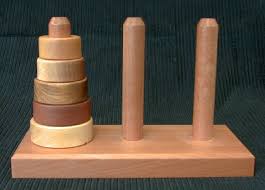
Play The Tower of Hanoi - A Famous Mathematical Game

From Wikipedia:

The Tower of Hanoi or Towers of Hanoi (also known as The Towers of Brahma) is a mathematical game or puzzle. It consists of three rods, and a number of disks of different sizes which can slide onto any rod. The puzzle starts with the disks neatly stacked in order of size on one rod, the smallest at the top, thus making a conical shape.

The objective of the puzzle is to move the entire stack to another rod, obeying the following rules:

  • Only one disk may be moved at a time.
  • Each move consists of taking the upper disk from one of the rods and sliding it onto another rod, on top of the other disks that may already be present on that rod.
  • No disk may be placed on top of a smaller disk.

This might be a simple game but it is a great tool to train your logic thinking.

Play the game here: http://www.mazeworks.com/hanoi/index.htm

You can try it with different number of disks. They even added the challenge of completing the game in the minimum moves. Solution is also provided should you face challenges in completing!

Have Fun!

For those who are interested in the history of this games, read more here.

I will be back in the next post to discuss on different approaches to a Additional Mathematics on Identity which falls in the topic of Factor Remainder Theorem. Look out for the next post!

Subscribe (it's free!) to singaporeolevelmaths.com by entering your email address in http://www.singaporeolevelmaths.com/feed

Filed Under: Cool stuff, Desserts Tagged With: games, puzzles

[Video] E-Math Popular Exam Question: Finding Ratio of Areas in Vectors (Includes 3 Strategies & Revision of Similar Triangles)

In this post, we are going to discuss on the applications of vectors - Finding Ratio of Areas. This is a popular section in examinations and based on my many years of experience, students simply don't like it due to many of them disliking and not making sense of the topic on Similar Triangles.

Strategy #1 : Similar Triangles

In Similar Triangles, the ratio of 2 similar triangles can be easily found by squaring the ratio of their corresponding length.

[pmath]({A_1}/{A_2})=({l_1}/{l_2})^2[/pmath]

Strategy #2 : Common Base/Common Height

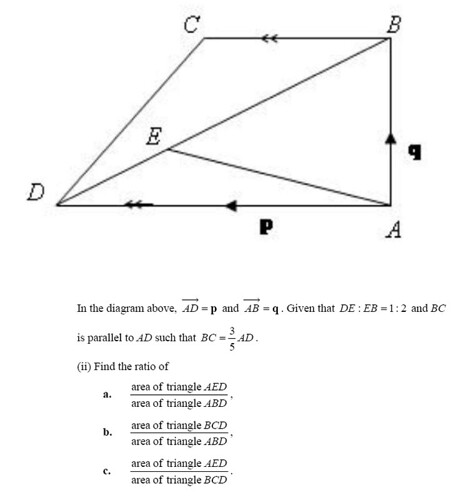
I am going to use this examination question below to illustrate the application of Strategy #2. This strategy works when the triangles shared either a common base or a common height. And that the triangles are not similar.

Watch the video below to find out if your answers are correct. Included in this video is a trick which will help you to 'see' your answer faster!

Rate the video or leave me a comment or question.

Strategy #3 : Overlap

When strategy 1 or 2 do not work and the question involves repeated triangles, overlap is the strategy you can apply. Overlap involves equalizing of ratio of THE triangle which overlaps.

Filed Under: E-Maths, Video Learning, Weekly Question Tagged With: ratio of areas in vectors, similar triangles, vectors

[Video]E-Math: Basics of Vectors (Plus: Video Solution of an Exam Question)

Vector is a nightmare for some students especially if you do not like Physics. But for O level Elementary Mathematics, the few concepts are still quite straightforward to grasp if you follow through step by step.

In this post, I am going to discuss the Basics of Vectors which include:

  • Finding magnitude of vectors
  • How to find vectors
  • Parallel vectors & its significance

This is the exam question used for illustration.

|Magnitude| of vectors

When vectors are given in column vector form: [pmath](matrix{2}{1}{x y})[/pmath], you can find the magnitude of the vectors usually by applying Pythagoras Theorem.

So magnitude of vectors = [pmath]sqrt{x^2+y^2}[/pmath]. If you do not wish to remember this, you can always draw a diagram in 5 seconds to be able to find the magnitude of any vectors. (This is shown in the video below)

How to find vectors

Finding vectors is just like deciding an alternate route for your journey. You would want to take note of the start point and the end point. For example, [pmath]vec{AB} = vec{AO} + vec{OB}[/pmath] My starting point is A, transition point is O and the end point is B.

Hint: When diagram is given, refer to diagram for help to plan the 'alternate' route. Otherwise, consider the points given in the question.Sometimes, 3 or more vectors can be involved.

Parallel Vectors

We can tell that 2 vectors are // to each other when they are expressed in this relationship:

[pmath]vec{AC} =k vec{BD}[/pmath] where k is a scalar factor.What this means is that [pmath]vec{AC}[/pmath] is // to [pmath]vec{BD}[/pmath] and the magnitude of [pmath]vec{AC}[/pmath] is k times that of [pmath]vec{BD}[/pmath]

We discuss about // vectors in parallelograms and trapeziums too!

Hint: Parallel vectors have same 'gradient'.

This is the question which I use to illustrate the 3 points above:

How did you find vectors so far? Is it easy to understand or you do not seem to know anything? Leave me your comments. I would love to hear from you!

In the next post, I will be discussing Finding Ratio of Areas in Vectors & the Strategies Involved.

Filed Under: E-Maths, Reader Question, Video Learning Tagged With: magnitude of vectors, parallel vectors, vectors

  • « Go to Previous Page
  • Go to page 1
  • Interim pages omitted …
  • Go to page 23
  • Go to page 24
  • Go to page 25
  • Go to page 26
  • Go to page 27
  • Interim pages omitted …
  • Go to page 54
  • Go to Next Page »

Copyright © 2023 · singaporeolevelmaths.com · Talk to us at 88290998