singaporeolevelmaths | Scoring A-Grade in Math & Life!

CAT | Reader Question

Some of the common questions I get around this period (before registration of GCE ‘O’ level exams) is that ‘Should I Drop A-Math?‘, ‘Can I still study H2 Math in JC if I didn’t take A-Math at O level?

This post is also suitable for Secondary two students who will be choosing their subject combination at the end of the year.

Should I Drop A-Math?’

This question usually pops out after a long period of unsuccessful attempts to pass A-Math or when it was recommended by teachers to drop the subject.

I have a poem to share: To Drop Or To Perserve On, Read the “Don’t Quit” Poem (Click to read)

Can I still study H2 Math in JC if I didn’t take A-Math at O level?

I have also answered this question previously in this post: What happens if I do not take A-Maths?

Just a note : I have recently communicated with Temasek Junior College (TJC) Math teacher. For students intending to study H1 Math (Art Stream), ‘O’ level A-Math is not a requirement.

  • Facebook
  • Twitter
  • Share/Bookmark

, , Hide

For the past month, other than being busy with the June Intensive Revision Programmes, I was also packed with Mid Year Exam Papers Review for my group of students.

I am pleased to announce that almost all see an improvement in their Mid Year Results (One boy has his grades jump from F9 to A2! Congrats, B!)

I was reviewing the school a-Math exam papers with one of my students during my A-Math Ultimate Leap Programme when she posted me a good question.

Let’s take a look at her Trigonometry question first:

This was her solution for the question:

There is one misconception in her thoughts, can you spot it?

sin 3x is not equal to sin x + sin 2x!

In fact, the correct formula to choose for this question is

sin 3x = sin (2x + x)

= sin2xcosx + cos2xsinx

Her question was: how do you know which formula to use?

TIP: When the angle involved is ODD, we usually use addition formula (just like in this question).

When angle is EVEN, double angle formula is perhaps the correct one to choose.

Are you confused just like my student, which formula should be use? Leave me a comment.

I hope this post has made your understanding clearer :-)

Below is a list of useful posts on A-Math Trigonometry:

  1. How To Prove Trigonometry Identity
  2. A-Math Trigo Graphs
  3. More A-Math Trigo Graphs
  4. Drawing of Trigo Graphs

PS: I will be re-running A-Math Trigonometry Mastery Workshop in July as some students miss out the one in June due to other commitments. Registration is open! Click here for more details

  • Facebook
  • Twitter
  • Share/Bookmark

, , Hide

Previously I have written a post on How to prepare for Maths common test. (It has been one of the most popular posts) Today, I am going to discuss the 3 Things You Should Not Do Before Any Math Exams:

Do not practice new Math questions

Practicing Math is something you should do consistently everyday but NOT before your Math exams. I do not encourage this as by you might get ‘freak’ out by questions that you could not do, did not get the correct answers. This will not do good for your confidence.

Do not think of doing last minute revision

The more you cramped, the worse it gets. Pre exam period is about taking everything as per normal day. You eat your breakfast as per normal. Do not burn midnight oil instead have an early rest. This will ensure that you have a clear logical mind to handle the questions the next day. Freshness is one of the important factors to do well in exams.

Do not prepare your cheat sheet the day before your exam

Revision for Math exams is unique from other subjects in the sense that all you need for a fast revision would be just a sheet of A4 Paper with all the required formula and important points on just ONE sheet of A4 paper, YOUR CHEAT SHEET. Now this cheat sheet should be prepared many days in advance, even while you are consistently revising and working on your Math. It should be a ’stale’ copy which you have been referring to for all your tests and exams.

I would love to hear from you what are the things you do or do not do on the eve of your Math Exams. Leave me a comment or question.

  • Facebook
  • Twitter
  • Share/Bookmark

, , Hide

Vector is a nightmare for some students especially if you do not like Physics. But for O level Elementary Mathematics, the few concepts are still quite straightforward to grasp if you follow through step by step.

In this post, I am going to discuss the Basics of Vectors which include:

  • Finding magnitude of vectors
  • How to find vectors
  • Parallel vectors & its significance

This is the exam question used for illustration.

|Magnitude| of vectors

When vectors are given in column vector form: (matrix{2}{1}{x y}), you can find the magnitude of the vectors usually by applying Pythagoras Theorem.

So magnitude of vectors = sqrt{x^2+y^2}. If you do not wish to remember this, you can always draw a diagram in 5 seconds to be able to find the magnitude of any vectors. (This is shown in the video below)

How to find vectors

Finding vectors is just like deciding an alternate route for your journey. You would want to take note of the start point and the end point. For example, vec{AB} = vec{AO} + vec{OB} My starting point is A, transition point is O and the end point is B.

Hint: When diagram is given, refer to diagram for help to plan the ‘alternate’ route. Otherwise, consider the points given in the question.Sometimes, 3 or more vectors can be involved.

Parallel Vectors

We can tell that 2 vectors are // to each other when they are expressed in this relationship:

vec{AC} =k vec{BD} where k is a scalar factor.What this means is that vec{AC} is // to vec{BD} and the magnitude of vec{AC} is k times that of vec{BD}

We discuss about // vectors in parallelograms and trapeziums too!

Hint: Parallel vectors have same ‘gradient’.

This is the question which I use to illustrate the 3 points above:

How did you find vectors so far? Is it easy to understand or you do not seem to know anything? Leave me your comments. I would love to hear from you!

In the next post, I will be discussing Finding Ratio of Areas in Vectors & the Strategies Involved.

  • Facebook
  • Twitter
  • Share/Bookmark

, , Hide

Feb/09

14

E-Math: Set Notations

Lately, I have received some readers’ request for me to discuss more about SET. This topic used to be in the GCE O level Additional Mathematics syllabus, but has recently made its appearance in Elementary Mathematics (E-Math)

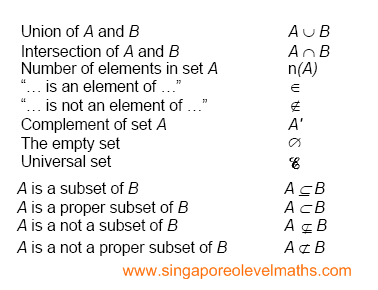
SET itself is yet another way of representation of data, like matrix. Just like matrix, we need to know about the ‘language’ for SET.

Here’s a list of notation which you must be familiar with:

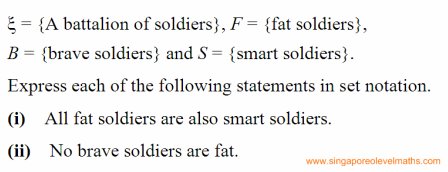
Below is a typical question which requires your translation skills from English to Set Notation:

TIP: Draw a set diagram to illustrate the statements first!

(i) clip_image002[4]

(ii) clip_image002[6]

  • Facebook
  • Twitter
  • Share/Bookmark

, , Hide

Events

About Ai Ling

Hi, my name is Ai Ling Ong and I'm a professional Math Trainer specializing in GCE 'O' level Mathematics (Additional & Elementary). More than 10 years of teaching experience, I have coached hundreds of students more than 80 schools in Singapore. Read more about me here
To top