• Skip to primary navigation
  • Skip to main content
singaporeolevelmaths

singaporeolevelmaths

Simple Tips for Better Maths Results!

  • Pass With Distinction A-Maths Programme
  • About
  • Books
    • O-Level Maths Ten Years Series Books
    • O-Level Pocket Summary
  • Videos
  • What They Say
  • Contact

Ai Ling Ong

E-Math: How To Multiply Matrices (Video)

This is my first attempt this year to produce a video. Should the response be good, I will use video to share more tips and strategies with my audience, so please leave me a comment.

Please pardon me the 'echo' effect in my introduction and also the low resolution. I was using my new logitech webcam :D

I'm working towards producing better quality videos. Share tips on this if you have any. Would appreciate it.

For more posts on matrix, please refer to the related posts below.

I look forward in hearing your comments and the answer to the question in the video.

Filed Under: E-Maths, Video Learning Tagged With: matrix multiplication, order of matrix

A-Math: Differentiation Shortcut Lies In Pausing & Simplifying

Differentiation is a big thing in fact major chapter for all Secondary 4 'O' level students.

Read all about the basics Differentiation techniques here. (Examples included) I would like to share one question from my A-Math Ultimate Leap Programme (weekly coaching class) which has 2 different approaches to solve it.

Example:

differentiation-qn

Very often, I notice students will jump into Quotient rule whenever a fraction is given. Just like this student here:

differentiation-qn-quotient-rule

May I suggest that you pause for 3 seconds to think about the approach. Ask yourself 'Is there anything I can simplify?'

Here's another student who pauses:

differentiation-qn-simplified

Notice this student spends his time simplifying before applying chain rule in differentiation.

I hope you enjoy this example. Both students are correct in their answers, which one do you prefer more? A or B?

Filed Under: A-Maths Tuition Tagged With: chain rule, differentiation, quotient rule, shortcut

Foods for Better Memory

One of the interesting questions I discuss with my students every year before major examinations is

'What foods would you recommend for brain?'

Photo Credit: Bob.Fornal

Generally, I have heard about 'berries' and fish help in memory.

It wasn't until recently that I came across an interesting article on Pickthebrain.com

Here's a summary of the foods recommended in the article:

  1. Herb: Rosemary
  2. Tea (Yes! The beverage)
  3. Fruits & Vegetables; colors for boosting memory are dark red, blue and green.
  4. Fish & Nuts
  5. Dessert: Honey

More details here: '5 Foods To Remember For Better Memory'.

So are there any specific foods you take to better your memory? I would love to hear from you! Leave me a comment.

Filed Under: Desserts, Exam Matters, Learning Tools Tagged With: before exams, food, memory

E-Math: Compound Interest Formula (Plus A Tricky Question)

Photo Credit:purpleslog

In today post,I'm going to talk about some concepts related to everyday life, we call this everyday Math. As you see the image on the side, you know I'm going to talk about money and where is money being 'stored'? Well, safely in the bank! So have you wondered why banks give you interest (peanuts though) for doing you a service of keeping your money safely? Should they charge you?

Today we are going to discuss about interest, compound interest in particular. I would strongly suggest you read these 2 posts before attempting the question first.

  1. Simple & Compound Interest
  2. Formula Usage on Simple & Compound Interest

These 2 posts discuss the basic concepts on the differences between Simple and Compound Interest as well as what you should note when using the formulas.

I came across the following question while doing an exampaper analysis for my student recently and it so coincides with the topics I want to discuss this week.

Example:

compound-interest-qn

Do the question yourself and check your level of understanding. It should take you 2 minutes.

Spot the error!

Common mistake (click here for image). Did you make this mistake too? Do you know where the error is?

Lesson Learnt

The correct working is shown here. (click)

compound-interest-formula-summary

Test out your understanding

If the original question is modified to compounded half-yearly with the principle amount of $75 000 being deposited at the same rate of 1.8% per annum, calculate the total amount at the end of 1 year. What would be your answer? Leave your answer in the comment section.

Filed Under: E-Maths Tagged With: compound interest, compound interest formula

A-Math: General Equation of Circle - Linked to Completing Square

In the previous post, I have discussed the standard equation of circle which is derived from distance formula.

The other equation of circle is known as General.

Example

general-eqn-circle-example

To answer this question easily, you need your completing square technique (Read about the steps here) which many students dislike!

You notice in the step by step solution, the general equation is converted into a standard equation through the following steps:

  1. Arrange all x terms and y terms together
  2. Start completing square
  3. Simplify all constants
  4. Set equation into standard equation of circle

General Equation to Standard Equation of Circle

convert-general-standard

Radius = 5 and Centre of circe = (4, 1)

I hope you have a better understanding on equation of circle.

Filed Under: A-Maths Tuition Tagged With: completing square, general equation of circle, standard equation of circle

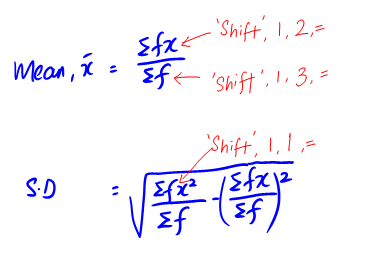
E-Math: How to Use the Mean and Standard Deviation Formula (Plus: Calculator Shortcuts)

One of the first topics that many Secondary 4 E-Math students learnt is a statistics chapter known as Mean and Standard Deviation (SD for short).

The nice thing about this chapter is that the 2 most important formula are both available in the E-Math (subject code: 4016) formula sheet! No memorization required, just understanding of their usage.

In this post, I will illustrate 2 methods to get the answers for mean and SD for ungrouped data (refer to example). The 2 methods are manual and calculator.

Example:

Given 15, 6, 18, 9, 2 and 4, find the mean and standard deviation.

Manual:

Mean and Standard Deviation Manual Working

Calculator, Casio fx-85MS:

  1. Mode, 2(SD)
  2. Enter the data in this manner, 15, M+ follows by 6, M+...
  3. To get mean: Press 'Shift', 2, 1,=
  4. To get SD: Press 'Shift', 2, 2,=

Here are some additional information you can obtain using the calculator:

Mean - SD from Calculator

Answers obtained through both methods are the same. By knowing these 2 methods, you can use either to double check.


Filed Under: E-Maths Tagged With: calculator skills, e-math formula sheet, mean, standard deviation, statistics, ungrouped data

  • « Go to Previous Page
  • Go to page 1
  • Interim pages omitted …
  • Go to page 16
  • Go to page 17
  • Go to page 18
  • Go to page 19
  • Go to page 20
  • Interim pages omitted …
  • Go to page 54
  • Go to Next Page »

Copyright © 2023 · singaporeolevelmaths.com · Talk to us at 88290998