singaporeolevelmaths | Scoring A-Grade in Math & Life!

TAG | statistics

I have previously written 2 posts:

E-Math: Drawing and Understanding of Cumulative Frequency Curve (Step by step working included)

In this post, I have used an examination question to illustrate how to draw a cumulative curve using the information from the cumulative table, how to use the curve to find median weight, how to find percentile.

E-Math: 5 Features of Box and Whisker Plot You Must Know

A summary is given on the essential parts of a Box and Whisker Plot. Do you know there’s a difference between interquartile range and range? Do you know how to read the upper & lower quartile, how to read the media?

Both are under the big topic of Statistics which is the most fun chapter as it relates really closely to what we see everyday.

Have fun!

Photo Credit: fdecomite

  • Facebook
  • Twitter
  • Share/Bookmark

Hide

One of the first topics that many Secondary 4 E-Math students learnt is a statistics chapter known as Mean and Standard Deviation (SD for short).

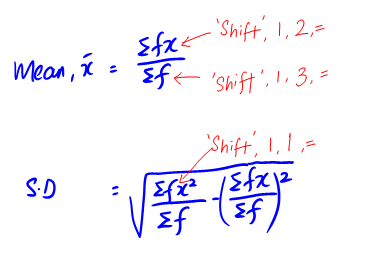
The nice thing about this chapter is that the 2 most important formula are both available in the E-Math (subject code: 4016) formula sheet! No memorization required, just understanding of their usage.

In this post, I will illustrate 2 methods to get the answers for mean and SD for ungrouped data (refer to example). The 2 methods are manual and calculator.

Example:

Given 15, 6, 18, 9, 2 and 4, find the mean and standard deviation.

Manual:

Mean and Standard Deviation Manual Working

Mean and Standard Deviation Manual Working

Calculator, Casio fx-85MS:

  1. Mode, 2(SD)
  2. Enter the data in this manner, 15, M+ follows by 6, M+…
  3. To get mean: Press ‘Shift’, 2, 1,=
  4. To get SD: Press ‘Shift’, 2, 2,=

Here are some additional information you can obtain using the calculator:

Mean - SD from Calculator

Mean - SD from Calculator

Answers obtained through both methods are the same. By knowing these 2 methods, you can use either to double check.


  • Facebook
  • Twitter
  • Share/Bookmark

, , , , , Hide

Link to what was previously discussed in Statistics (an Elementary Math E-Math topic) in Drawing & Understanding of Cumulative Frequency, here are the 5 features for a Box & Whisker Plot (I guess you would know which part represents the box, and the portion which are the whiskers)

  1. Minimum
  2. Lower Quartile, Q1
  3. Median
  4. Higher Quartile, Q3
  5. Maximum

Note the difference between these 2 terms:

Range = Max – Min
Interquartile Range (IQR) = Q3 – Q1

  • Facebook
  • Twitter
  • Share/Bookmark

, , Hide

Let’s use this question to discuss on drawing and using cumulative frequency curve.

(Click on image to enlarge)

(a) Drawing of cumulative freq curve

cumulativefreqcurve

(Click on image to enlarge)

Step by step solutions:

Notes:

140 pupils weigh 72.5 kg or less. So if you are interested to find out the number of pupils who weigh more than 72.5 kg. It will be 280 (total number of pupils) – 140 = 140 pupils.

Special attention to (iii) no. of students who weigh more than 65kg. By going UP & ACROSS, we get 20 students. This only means 20 students weigh 65 kg or less. So the rest (280 – 20 = 260) will weigh more than 65 kg

In my next post, I will be discussing the features of box and whisker plot.

  • Facebook
  • Twitter
  • Share/Bookmark

, Hide

Events

About Ai Ling

Hi, my name is Ai Ling Ong and I'm a professional Math Trainer specializing in GCE 'O' level Mathematics (Additional & Elementary). More than 10 years of teaching experience, I have coached hundreds of students more than 80 schools in Singapore. Read more about me here
To top