
For more details, please go to seab website or call MOE Customer Service Centre at 6872 2220

singaporeolevelmaths
Simple Tips for Better Maths Results!
For more details, please go to seab website or call MOE Customer Service Centre at 6872 2220

I have previously written 2 posts:
E-Math: Drawing and Understanding of Cumulative Frequency Curve (Step by step working included)
In this post, I have used an examination question to illustrate how to draw a cumulative curve using the information from the cumulative table, how to use the curve to find median weight, how to find percentile.
E-Math: 5 Features of Box and Whisker Plot You Must Know
A summary is given on the essential parts of a Box and Whisker Plot. Do you know there's a difference between interquartile range and range? Do you know how to read the upper & lower quartile, how to read the media?
Both are under the big topic of Statistics which is the most fun chapter as it relates really closely to what we see everyday.
Have fun!
Photo Credit: fdecomite
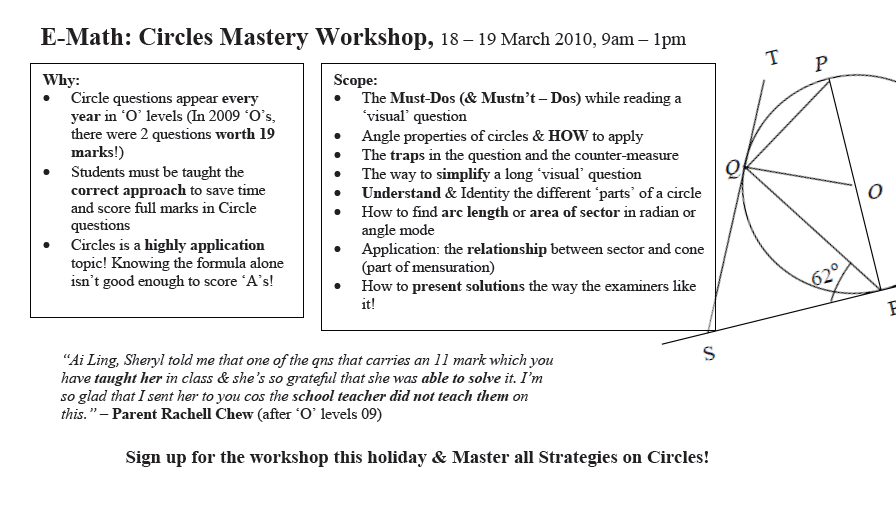
More on 'O' Level E-Math Circles Revision Workshop (Click here)

Photo Credit: mysza831
One of the applications of Differentiation is to determine the type of stationary point. This application is common in maximum and minimum problems.
There are two ways to go about finding the type of stationary point. The more frequently used method is through Second Derivative (Watch the video here). (d^2y/dx^2)
However, I'm not going to discuss on that method. Instead I want to share with you on the less popular method which is First Derivative. The reason: I have observed that last 2 years, questions appearing in the GCE 'O' level Additional Mathematics were less commonly seen, least expected and definitely more nerve breaking for candidates who aren't prepared.
Let's take a look at how First Derivative is applied. [Read more...] about A-Math: Type of Stationary Point through First Derivative

Photo Credit:Viernest
In E-Math, one of the commonly asked questions in Paper 1 usually involved Kinematics (which is closely associated with motion) and in E-Math, we discuss about Distance, Speed and Acceleration.
One of the important definitions all students must know is acceleration. It's defined simply as the change of velocity with time.
I'm going to use the following example to highlight the types of information we can obtain from a speed-time graph. It contains my handwriting, hope it works well for you ;)
Try out the question before peeping at my solutions. (Highlighted parts = important formula)


This topic is taught in Secondary 3 after introduction of Indices Law.
In solving indices equation involving the same base, one of the common techniques is by Substitution. But before you can do substitution, you need to apply indices law to 'break down' the equation. This process of breaking down is sometimes challenging for students. Knowing how to solve quadratic equation is also essential.
Sometimes, solving Indices Equation will also involve the concept of taking lg on both sides as well.
In the following example, you will Substitution and 'Breaking down' in action: [Read more...] about A-Math: Solving Indices Equation (Involving Common Base)