TAG | compound interest
26
E-Math: Compound Interest Formula (Plus A Tricky Question)
7 Comments | Posted by alwaysLovely in E-Math

Photo Credit:purpleslog
In today post,I’m going to talk about some concepts related to everyday life, we call this everyday Math. As you see the image on the side, you know I’m going to talk about money and where is money being ’stored’? Well, safely in the bank! So have you wondered why banks give you interest (peanuts though) for doing you a service of keeping your money safely? Should they charge you?
Today we are going to discuss about interest, compound interest in particular. I would strongly suggest you read these 2 posts before attempting the question first.
These 2 posts discuss the basic concepts on the differences between Simple and Compound Interest as well as what you should note when using the formulas.
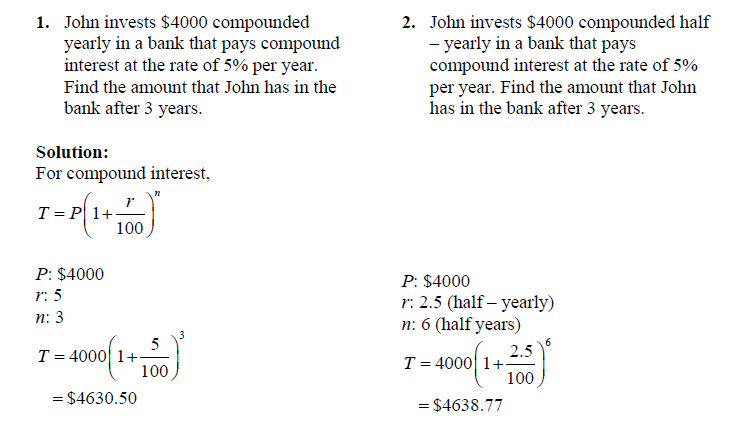
I came across the following question while doing an exampaper analysis for my student recently and it so coincides with the topics I want to discuss this week.
Example:
Do the question yourself and check your level of understanding. It should take you 2 minutes.
Spot the error!
Common mistake (click here for image). Did you make this mistake too? Do you know where the error is?
Lesson Learnt
The correct working is shown here. (click)
Test out your understanding
If the original question is modified to compounded half-yearly with the principle amount of $75 000 being deposited at the same rate of 1.8% per annum, calculate the total amount at the end of 1 year. What would be your answer? Leave your answer in the comment section.
28
Formulae Usage On Simple And Compound Interest
4 Comments | Posted by alwaysLovely in E-Math
We have discussed about Simple And Compound Interest using 2 case studies previously based on concepts understanding. Now we have introduced formulaes which will make your calculation faster and easier :)
To find the Total Amount based on Simple Interest, this is the formuale you can use:
An : Total Amount after n years
P: Original Principal Amount
r: Simple Interest Rate
n: Number of Years
To find the Total Amount based on Compound Interest, this is the formuale you can use:
An : Total Amount after n years
P: Original Principal Amount
r: Compound Interest Rate
n: Number of Years
Apply these formulaes to the case studies we have discussed, did you get the same answer?
Congrats!Now you have 2 different approaches, the formulae way or the conventional way to solve all Interest questions.
Keep using the strategies learnt so that you get better and better.
Given a choice between the 2 different types of interest, which will you choose? This is taught under Elementary Mathematics (E-Math)
Before you make the smart choice, let’s examine the differences between these 2 different types of interest through an example.
CASE OF SIMPLE INTEREST
alwaysLovely deposited $1000 into Bank A for 2 years which pays a simple interest of 10% p.a.( per annum –> per year). How much will she get at the end of 2 years?
1 year –>10% , 2 years –> 20%
Total interest earned for 2 years = 1000 * 20% = $200
Total amount = $1000 + $200 = $1200
CASE OF COMPOUND INTEREST
alwaysLovely deposited $1000 into Bank B for 2 years which pays a compound interest of 10% p.a. How much will she get at the end of 2 years?
Interest earned in Year 1 = 1000 * 10% = $100
Principal Amount for Year 2 = $1000 + $100 = $1100
Interest earned in Year 2 = 1100 * 10% = $110 /*Interest is calculated based on the new principal amount*/
Total amount received for 2 years = $1000 + $100 + $110 = $1210
So which is better, Bank A or Bank B ?
Check out the next post on Formulae Usage on Simple And Compound Interest which will reduce your time to reach your correct answer.