

E-Maths
O Level A-Math and E-Math June Holidays Intensive Revision Programme
 We thank you for your patience for our O Level A-Math and E-Math June Holidays Intensive Revision Programme : Be Prepared For Your O Levels This June.
It is less than 24 weeks from the GCE O Level Examinations.
Are your concepts strong or weak?
Are you mentally prepared or not?
Are you afraid of certain A-Math topics like
Trigonometry (Proving Identity, Solving Equations, R-Formula, Sketching of Trigonometry Graphs...), Differentiation & Integration (Very Very Important topics),
Logarithms and Linear Graphs,
Quadratic Equations & Its Applications?
Or are you confused on these E-Math topics like
Vectors
Statistics (Box & Whisker Diagram, Stem & Leaf, Mean, Standard Deviation, Cumulative Frequency, Median, Mode) & Probability
Graphs Mastery (Inclusive of Quadratic Graphs, Distance, Speed Time Graphs, Graphs of Power Functions, Gradient of Curves)
Trigonometry (Angles of Elevation & Depression; Very Very important topic)?
In which is the case, you want to make use of this 'last' holidays to catch up, revise on the topics which you are not strong yet.
Winners Education Group is organizing a June Holidays Intensive Revision Programme for all Secondary 3 & 4s students so that you get prepared with the concepts, strategies to score your distinctions for your GCE O Levels.
Here's the schedule for the O Level A-Math and E-Math June Holidays Intensive Revision Programme:

 For more registration details, click here. We will get back to you within 2 days.
“A-Math used to be such an abstract subject for me. I couldn’t make sense of what I was taught and I did not pass any of my A-Math exams or tests previously. Joining this A Math Intensive programme was turning point for me; I wish I was taught the strategies earlier! They were simple and easy to use as I learnt how to “see” A-Math better. Thanks for the belief in me! “ Vanessa Lim, E8 to A2 (3 months), MGS
Click here to hear what others say about us
Leave us your questions or comments at the end of the post.
June Holidays E-Math (Elementary Math) Revision Programme

Latest Update: The schedule of June Holidays Intensive Revision of O Level Elementary Math & Additional Math is available now! Click here for more info.
Here's What I Have:
We will be organizing an Elementary Math Revision Programme for all Secondary 4 & 5 Students (Subject Code: 4016) this June holidays.
- ***Trigonometry Mastery Workshop (2 Days, Total time: 8 hours) Including Angles of Elevation, Depression, usage of area of triangle, sin, cos rule for application of 2D & 3D problems
- ***Vectors Mastery Workshop (2 Days, Total time: 8 hours)
- Statistics Mastery Workshop (2 Days, Total time: 8 hours) Including Cumulative Frequency, Box & Whisker, Stem & Leaf, Mean & Standard Deviation, Mean, Mode & Median, Basic Probability
- Graphs Mastery Workshop (3 Days, Total time: 12 hours) Including General Shape, Quadratic Graphs & Completed Square, Applications, Kinematics
*** Heavy weightage in Exams & Killer Topics for Elementary Mathematics
Here's what this E-Math Mastery Workshops Will Do For You: In these workshops, you will learn:
- How to apply basic concepts to real exam questions through proven strategies
- How to cross - link different related concepts together to see the big picture clearer
- How to answer to the question by identifying keywords
- How to manage time effectively to complete questions fast and accurate
- How to master E-Math confidently through hands on experience and active participation.
- How to learn new concepts quickly and remember more within the shortest time.
- How to apply correct strategies correctly in a systematic manner.
- How to tackle questions with ease by asking the right set of questions
Here's What You Need To Do Now:
- Fill up the form below and we will keep you updated of the registration.
Note: Registration will stop once class is full. Limited Seats only!
"Dear Ms. Ling,
Thank you so much for the photos and looking forward to the work she has done for the past 4 days.
I’m very contented that she has learnt alot from this workshop and my money is worth it. Appreciate you help in motivating and making A-Maths a joyful and interesting workshop for my kid.Tks"
Shoba (Parent of Devyaah)
[Video] E-Math Popular Exam Question: Finding Ratio of Areas in Vectors (Includes 3 Strategies & Revision of Similar Triangles)
In this post, we are going to discuss on the applications of vectors - Finding Ratio of Areas. This is a popular section in examinations and based on my many years of experience, students simply don't like it due to many of them disliking and not making sense of the topic on Similar Triangles.
Strategy #1 : Similar Triangles
In Similar Triangles, the ratio of 2 similar triangles can be easily found by squaring the ratio of their corresponding length.
[pmath]({A_1}/{A_2})=({l_1}/{l_2})^2[/pmath]
Strategy #2 : Common Base/Common Height
I am going to use this examination question below to illustrate the application of Strategy #2. This strategy works when the triangles shared either a common base or a common height. And that the triangles are not similar.
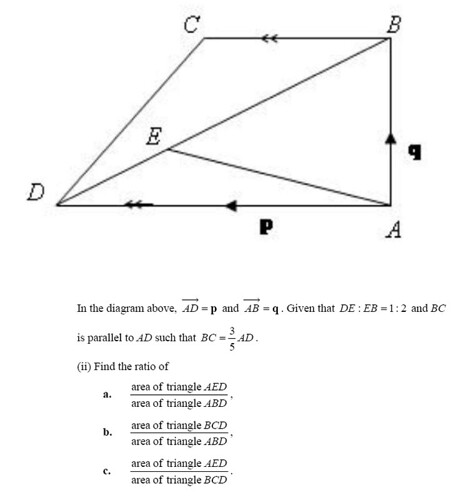
Watch the video below to find out if your answers are correct. Included in this video is a trick which will help you to 'see' your answer faster!
Rate the video or leave me a comment or question.
Strategy #3 : Overlap
When strategy 1 or 2 do not work and the question involves repeated triangles, overlap is the strategy you can apply. Overlap involves equalizing of ratio of THE triangle which overlaps.
[Video]E-Math: Basics of Vectors (Plus: Video Solution of an Exam Question)
Vector is a nightmare for some students especially if you do not like Physics. But for O level Elementary Mathematics, the few concepts are still quite straightforward to grasp if you follow through step by step.
In this post, I am going to discuss the Basics of Vectors which include:
- Finding magnitude of vectors
- How to find vectors
- Parallel vectors & its significance
This is the exam question used for illustration.

|Magnitude| of vectors
When vectors are given in column vector form: [pmath](matrix{2}{1}{x y})[/pmath], you can find the magnitude of the vectors usually by applying Pythagoras Theorem.
So magnitude of vectors = [pmath]sqrt{x^2+y^2}[/pmath]. If you do not wish to remember this, you can always draw a diagram in 5 seconds to be able to find the magnitude of any vectors. (This is shown in the video below)
How to find vectors
Finding vectors is just like deciding an alternate route for your journey. You would want to take note of the start point and the end point. For example, [pmath]vec{AB} = vec{AO} + vec{OB}[/pmath] My starting point is A, transition point is O and the end point is B.
Hint: When diagram is given, refer to diagram for help to plan the 'alternate' route. Otherwise, consider the points given in the question.Sometimes, 3 or more vectors can be involved.
Parallel Vectors
We can tell that 2 vectors are // to each other when they are expressed in this relationship:
[pmath]vec{AC} =k vec{BD}[/pmath] where k is a scalar factor.What this means is that [pmath]vec{AC}[/pmath] is // to [pmath]vec{BD}[/pmath] and the magnitude of [pmath]vec{AC}[/pmath] is k times that of [pmath]vec{BD}[/pmath]
We discuss about // vectors in parallelograms and trapeziums too!
Hint: Parallel vectors have same 'gradient'.
This is the question which I use to illustrate the 3 points above:
How did you find vectors so far? Is it easy to understand or you do not seem to know anything? Leave me your comments. I would love to hear from you!
In the next post, I will be discussing Finding Ratio of Areas in Vectors & the Strategies Involved.
E-Math: Set Notations
Lately, I have received some readers' request for me to discuss more about SET. This topic used to be in the GCE O level Additional Mathematics syllabus, but has recently made its appearance in Elementary Mathematics (E-Math)
SET itself is yet another way of representation of data, like matrix. Just like matrix, we need to know about the 'language' for SET.
Here's a list of notation which you must be familiar with:
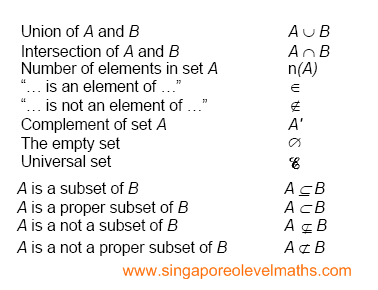
Below is a typical question which requires your translation skills from English to Set Notation:
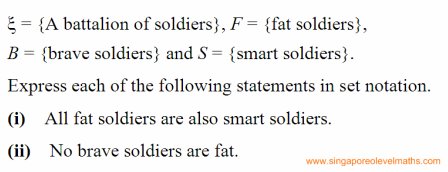
TIP: Draw a set diagram to illustrate the statements first!

(i) ![clip_image002[4]](http://www.singaporeolevelmaths.com/wp-content/uploads/2009/02/clip-image0024.gif)
(ii) ![clip_image002[6]](http://www.singaporeolevelmaths.com/wp-content/uploads/2009/02/clip-image0026.gif)