• Skip to primary navigation
  • Skip to main content
singaporeolevelmaths

singaporeolevelmaths

Simple Tips for Better Maths Results!

  • Pass With Distinction A-Maths Programme
  • About
  • Books
    • O-Level Maths Ten Years Series Books
    • O-Level Pocket Summary
  • Videos
  • What They Say
  • Contact

E-Maths

E-Math: How to Use the Mean and Standard Deviation Formula (Plus: Calculator Shortcuts)


One of the first topics that many Secondary 4 E-Math students learnt is a statistics chapter known as Mean and Standard Deviation (SD for short).

The nice thing about this chapter is that the 2 most important formula are both available in the E-Math (subject code: 4016) formula sheet! No memorization required, just understanding of their usage.

In this post, I will illustrate 2 methods to get the answers for mean and SD for ungrouped data (refer to example). The 2 methods are manual and calculator.

Example:

Given 15, 6, 18, 9, 2 and 4, find the mean and standard deviation.

Manual:

Mean and Standard Deviation Manual Working

Calculator, Casio fx-85MS:

  1. Mode, 2(SD)
  2. Enter the data in this manner, 15, M+ follows by 6, M+...
  3. To get mean: Press 'Shift', 2, 1,=
  4. To get SD: Press 'Shift', 2, 2,=

Here are some additional information you can obtain using the calculator:
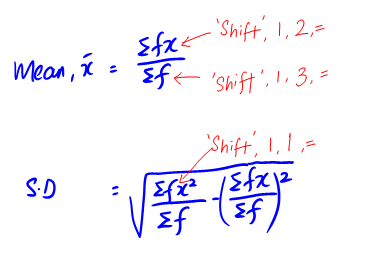
Mean - SD from Calculator

Answers obtained through both methods are the same. By knowing these 2 methods, you can use either to double check.


Filed Under: E-Maths Tagged With: calculator skills, e-math formula sheet, mean, standard deviation, statistics, ungrouped data

E-Math: Introduction to Vectors


In Secondary 4, students are going to learn this chapter 'Vectors'. Some love it, most hate it.

In today post, I'm going to share some basic concepts on Vectors.

What is a vector?

A vector is a quantity that has direction and magnitude. Common examples of vector include velocity, acceleration, displacement and force.

The opposite of vector is scalar, a quantity that has only magnitude. Examples include time, speed, distance and mass.

As you see, vector is closely associated with physics!

How do we represent a vector?

vector
vector

Since vector involves magnitude and direction, there will always be an arrow indicting the direction. We call this vector

Vectors can be expressed in a column format called column vector. For this example, which means, starting from point A, 3 units to right and 1 unit up. It is similar to our coordinate system 3 units along x axis and 1 unit along y axis. In general, moving right and up have positive sign while moving left and down have negative sign.

In general:

How to find magnitude of a vector?

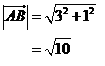
Using the same example,to find magnitude of , we use Pythagoras's Theorem. (Refer to diagram above)

Magnitude of can be written as .

I hope you have understood the basic concepts of vectors. In future post, I'm going to write more about the application of vectors.

Filed Under: E-Maths Tagged With: coordinate geometry, magnitude of vectors, pythagoras theorem, vector

E-Math: Interesting Probability Math Teaser (Plus usage of Tree Diagram)


You are a prisoner sentenced to death. The Emperor offers you a chance to live by playing a simple game. He gives you 50 black marbles, 50 white marbles and 2 empty bowls. He then says, "Divide these 100 marbles into these 2 bowls. You can divide them any way you like as long as you use all the marbles. Then I will blindfold you and mix the bowls around. You then can choose one bowl and remove ONE marble. If the marble is WHITE you will live, but if the marble is BLACK... you will die."

How do you divide the marbles up so that you have the greatest probability of choosing a WHITE marble?

Do you know how? ;) Leave your answer in the comment section. I will reveal the answer if anyone is interested to know.

In E-Math, we discussed about probability on possibility diagram, tree diagram, mutually exclusive events, independent events. Fortunately we do not go into permutation and combination where things get slightly more exciting.

Do you use more of tree  or possibility diagram  to help you in your probability question?

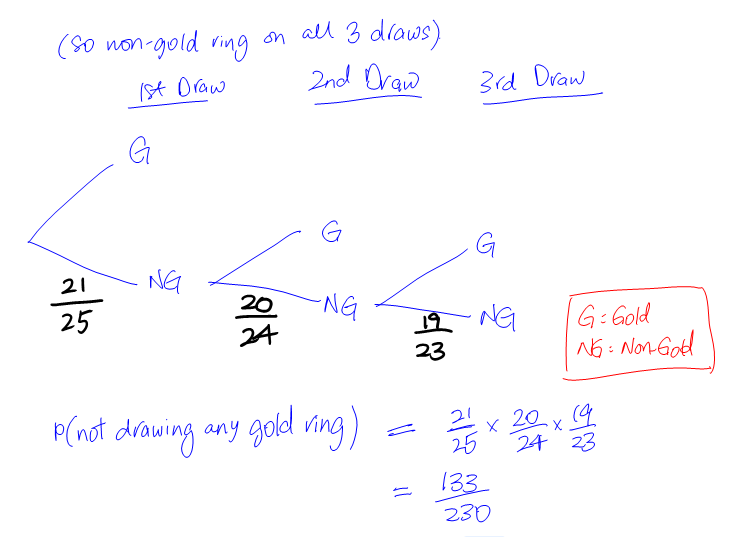
I'm going to show you an example of modified tree diagram to solve the following question

Bag A contains 15 bronze rings, 6 silver rings and 4 gold rings. Three rings are drawn at random, one after the other without replacement from bag A.

Calculate the probability of not drawing any gold ring.

modified-tree-diagram

Additional question: Calculate the probability of drawing all three rings that are different.

Filed Under: E-Maths Tagged With: probability, tree diagram

E-Math: How to Translate a "Proportion Statement" Into an Equation


(Photo Credit:Jeff Keen)

I love to use everyday life examples to teach Math Concepts, it's more interesting to me and my students.

Today, I'm going to use the concept of 'See-Saw' to share with you on 'How to Translate a "Proportion Statement" Into an Equation'

At the end of this post, you will be able to translate all types of statement (be it inversely proportion or direct proportion) into an equation (some called it a formula)

Direct Proportion statement:

You need to first understand what's Direct Proportion (Read all about it here)

Let's look at an example: Given y is directly proportional to [pmath]{x^2}[/pmath], write an equation connecting x, y and a constant k.

So, in simple terms, when y increases, x increases too.

Inverse (Indirect) Proportion statement:

Given y is inversely proportional to [pmath]{x+2}[/pmath], write an equation connecting x, y and a constant k.

This is similar to the situation when a See-Saw is in Up-Down position. y is up while (x+2) is down. You can also see it from another point: y is in the numerator while (x+2) is in the denominator or when y increases, x decreases.

I hope you have understand the easier way to translate statements into equations for proportionality question.

In my next post, I will be sharing the various approaches in solving a proportionality question and the hint to look out for in order to use the correct approach.

Filed Under: E-Maths Tagged With: direct proportion, inverse proportion

E-Math: What is Direct Proportion and Inverse Proportion?


Proportion is a topic taught in Secondary 1 and 2. In fact, we have learnt about direct proportion much younger.

DIRECT PROPORTION

A real simple example of Direct Proportion would be the more money I have, the more things I can buy. When amount of money increases, the number things I can buy increase too. (Notice the increase in both things)

Another example, the less I eat, the thinner I become, so as the amount of food eaten decreases, my weight decreases too.

INVERSE PROPORTION

An example of inverse proportion most of you can relate to would be: the more time I spent on Facebook (PSP, WII, Internet), the less time I have on my books!

Allow me to add in another example of Inverse Proportion, the more I spent, the less I have in my bank.

These are some examples (simple) to understand the true meaning of Direct or Inverse proportion.

In the next post, I will be sharing with you how we can translate a statement into an equation involving proportion. I'm also going to highlight the 'tricky' proportion question in 2008 GCE O Level Elementary Mathematics Paper 1.

Filed Under: E-Maths, Weekly Question Tagged With: direct proportion, inverse proportion

Your Questions on O level A/E-Math & Chemistry June Intensive Revision Programme Answered


We thank you for the many email questions regarding our O level A/E-Math & Chemistry June Intensive Revision Programme.

In this video, I have personally answered the following commonly asked questions by students (Secondary 3 & 4 + IP + IGCSE Programme) & parents:

  • Scope of programme
  • Benefits of attending our programme
  • Fees
  • Proven track record (on the effectiveness of our coaching)

If you can't view this video, please click here to the direct video link:

Leave me a comment below or any other questions you have.

I look forward in making a difference in your child's academic success!

Filed Under: A-Maths Tuition, about singaporeolevelmaths, E-Maths, Exam Matters, Tuition | Coaching Matters Tagged With: intensive revision programme, o level chemistry, singapore o level maths

  • « Go to Previous Page
  • Go to page 1
  • Interim pages omitted …
  • Go to page 5
  • Go to page 6
  • Go to page 7
  • Go to page 8
  • Go to page 9
  • Interim pages omitted …
  • Go to page 12
  • Go to Next Page »

Copyright © 2023 · singaporeolevelmaths.com · Talk to us at 88290998