• Skip to primary navigation
  • Skip to main content
singaporeolevelmaths

singaporeolevelmaths

Simple Tips for Better Maths Results!

  • Pass With Distinction A-Maths Programme
  • About
  • Books
    • O-Level Maths Ten Years Series Books
    • O-Level Pocket Summary
  • Videos
  • What They Say
  • Contact

E-Maths

E-Math: Parallel Vectors & Collinear


How to tell if 2 vectors are //?

It's easy if you're given a diagram. What if a diagram isn't provided? Then we need to look at relationship between the vectors.

As long as 2 vectors are expressed as scalar multiple of each other, the 2 vectors are //. What exactly do I mean? Look at the following example equations, they are examples of vectors // to each other.

This also means if you're able to establish such relationship between 2 vectors, you can prove that the vectors are // to each other.

parallel-vectors

Very often, question will ask you to explain why A, B and C lie on a straight line. (Look at Example 3)

The term to describe 3 points on the line is known as Collinear.

3 Points to show Collinear

  1. Establish a relationship between the 2 vectors
  2. Conclude that the 2 vectors are // to each other
  3. Common point is present

show-collinear

We can even draw a diagram to represent the two vectors. Since the relationship between the 2 vectors has a negative sign, it means that vectors AB and AC are in opposite direction. Vector AC is also twice of vector AB.

collinear

Do you have other ways to prove 3 points are collinear? I would love to hear from you.

Do you know that if you are asked to prove 2 vectors are //? A similar approach can also be used.

Follow me on twitter if you like to have more 'O' Level Math Tips.

Filed Under: E-Maths Tagged With: parallel vectors

E-Math: Summary of Cumulative Frequency & Box Whisker Plot


I have previously written 2 posts:

E-Math: Drawing and Understanding of Cumulative Frequency Curve (Step by step working included)

In this post, I have used an examination question to illustrate how to draw a cumulative curve using the information from the cumulative table, how to use the curve to find median weight, how to find percentile.

E-Math: 5 Features of Box and Whisker Plot You Must Know

A summary is given on the essential parts of a Box and Whisker Plot. Do you know there's a difference between interquartile range and range? Do you know how to read the upper & lower quartile, how to read the media?

Both are under the big topic of Statistics which is the most fun chapter as it relates really closely to what we see everyday.

Have fun!

Photo Credit: fdecomite

Filed Under: E-Maths Tagged With: statistics

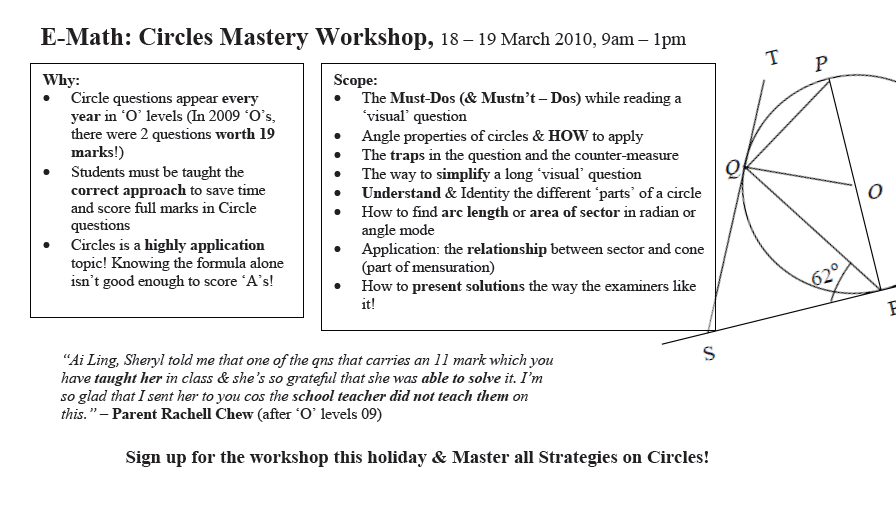
'O' Level Revision Workshops for E-Math & A-Math (March Holidays)


Click for bigger image

More on 'O' Level E-Math Circles Revision Workshop (Click here)

Filed Under: A-Maths Tuition, E-Maths, Workshop Tagged With: holiday programme

E-Math: Basic Concepts On Distance, Speed, Acceleration - Time Graphs


Photo Credit:Viernest

In E-Math, one of the commonly asked questions in Paper 1 usually involved Kinematics (which is closely associated with motion) and in E-Math, we discuss about Distance, Speed and Acceleration.

One of the important definitions all students must know is acceleration. It's defined simply as the change of velocity with time.

I'm going to use the following example to highlight the types of information we can obtain from a speed-time graph. It contains my handwriting, hope it works well for you ;)

Try out the question before peeping at my solutions. (Highlighted parts = important formula)

speed-time graph

speed-time-graph-solutions

Filed Under: E-Maths Tagged With: speed-time graphs

E-Math: How To Multiply Matrices (Video)


This is my first attempt this year to produce a video. Should the response be good, I will use video to share more tips and strategies with my audience, so please leave me a comment.

Please pardon me the 'echo' effect in my introduction and also the low resolution. I was using my new logitech webcam :D

I'm working towards producing better quality videos. Share tips on this if you have any. Would appreciate it.

For more posts on matrix, please refer to the related posts below.

I look forward in hearing your comments and the answer to the question in the video.

Filed Under: E-Maths, Video Learning Tagged With: matrix multiplication, order of matrix

E-Math: Compound Interest Formula (Plus A Tricky Question)


Photo Credit:purpleslog

In today post,I'm going to talk about some concepts related to everyday life, we call this everyday Math. As you see the image on the side, you know I'm going to talk about money and where is money being 'stored'? Well, safely in the bank! So have you wondered why banks give you interest (peanuts though) for doing you a service of keeping your money safely? Should they charge you?

Today we are going to discuss about interest, compound interest in particular. I would strongly suggest you read these 2 posts before attempting the question first.

  1. Simple & Compound Interest
  2. Formula Usage on Simple & Compound Interest

These 2 posts discuss the basic concepts on the differences between Simple and Compound Interest as well as what you should note when using the formulas.

I came across the following question while doing an exampaper analysis for my student recently and it so coincides with the topics I want to discuss this week.

Example:

compound-interest-qn

Do the question yourself and check your level of understanding. It should take you 2 minutes.

Spot the error!

Common mistake (click here for image). Did you make this mistake too? Do you know where the error is?

Lesson Learnt

The correct working is shown here. (click)

compound-interest-formula-summary

Test out your understanding

If the original question is modified to compounded half-yearly with the principle amount of $75 000 being deposited at the same rate of 1.8% per annum, calculate the total amount at the end of 1 year. What would be your answer? Leave your answer in the comment section.

Filed Under: E-Maths Tagged With: compound interest, compound interest formula

  • « Go to Previous Page
  • Go to page 1
  • Interim pages omitted …
  • Go to page 4
  • Go to page 5
  • Go to page 6
  • Go to page 7
  • Go to page 8
  • Interim pages omitted …
  • Go to page 12
  • Go to Next Page »

Copyright © 2023 · singaporeolevelmaths.com · Talk to us at 88290998