
In Secondary 4, students are going to learn this chapter 'Vectors'. Some love it, most hate it.
In today post, I'm going to share some basic concepts on Vectors.
What is a vector?
A vector is a quantity that has direction and magnitude. Common examples of vector include velocity, acceleration, displacement and force.
The opposite of vector is scalar, a quantity that has only magnitude. Examples include time, speed, distance and mass.
As you see, vector is closely associated with physics!
How do we represent a vector?

Since vector involves magnitude and direction, there will always be an arrow indicting the direction. We call this vector 
Vectors can be expressed in a column format called column vector. For this example,  which means, starting from point A, 3 units to right and 1 unit up. It is similar to our coordinate system 3 units along x axis and 1 unit along y axis. In general, moving right and up have positive sign while moving left and down have negative sign.
In general: 
How to find magnitude of a vector?
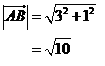
Using the same example,to find magnitude of  , we use Pythagoras's Theorem. (Refer to diagram above)
Magnitude of can be written as  .
.
I hope you have understood the basic concepts of vectors. In future post, I'm going to write more about the application of vectors.