
• Skip to primary navigation
  • Skip to main content
singaporeolevelmaths

singaporeolevelmaths

Simple Tips for Better Maths Results!

  • Pass With Distinction A-Maths Programme
  • About
  • Books
    • O-Level Maths Ten Years Series Books
    • O-Level Pocket Summary
  • Videos
  • What They Say
  • Contact

Archives for March 2009

[Video] E-Math Popular Exam Question: Finding Ratio of Areas in Vectors (Includes 3 Strategies & Revision of Similar Triangles)

In this post, we are going to discuss on the applications of vectors - Finding Ratio of Areas. This is a popular section in examinations and based on my many years of experience, students simply don't like it due to many of them disliking and not making sense of the topic on Similar Triangles.

Strategy #1 : Similar Triangles

In Similar Triangles, the ratio of 2 similar triangles can be easily found by squaring the ratio of their corresponding length.

[pmath]({A_1}/{A_2})=({l_1}/{l_2})^2[/pmath]

Strategy #2 : Common Base/Common Height

I am going to use this examination question below to illustrate the application of Strategy #2. This strategy works when the triangles shared either a common base or a common height. And that the triangles are not similar.
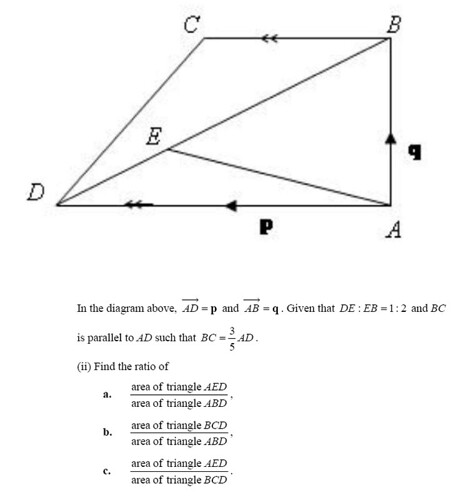
Watch the video below to find out if your answers are correct. Included in this video is a trick which will help you to 'see' your answer faster!

Rate the video or leave me a comment or question.

Strategy #3 : Overlap

When strategy 1 or 2 do not work and the question involves repeated triangles, overlap is the strategy you can apply. Overlap involves equalizing of ratio of THE triangle which overlaps.

Filed Under: E-Maths, Video Learning, Weekly Question Tagged With: ratio of areas in vectors, similar triangles, vectors

[Video]E-Math: Basics of Vectors (Plus: Video Solution of an Exam Question)

Vector is a nightmare for some students especially if you do not like Physics. But for O level Elementary Mathematics, the few concepts are still quite straightforward to grasp if you follow through step by step.

In this post, I am going to discuss the Basics of Vectors which include:

  • Finding magnitude of vectors
  • How to find vectors
  • Parallel vectors & its significance

This is the exam question used for illustration.

|Magnitude| of vectors

When vectors are given in column vector form: [pmath](matrix{2}{1}{x y})[/pmath], you can find the magnitude of the vectors usually by applying Pythagoras Theorem.

So magnitude of vectors = [pmath]sqrt{x^2+y^2}[/pmath]. If you do not wish to remember this, you can always draw a diagram in 5 seconds to be able to find the magnitude of any vectors. (This is shown in the video below)

How to find vectors

Finding vectors is just like deciding an alternate route for your journey. You would want to take note of the start point and the end point. For example, [pmath]vec{AB} = vec{AO} + vec{OB}[/pmath] My starting point is A, transition point is O and the end point is B.

Hint: When diagram is given, refer to diagram for help to plan the 'alternate' route. Otherwise, consider the points given in the question.Sometimes, 3 or more vectors can be involved.

Parallel Vectors

We can tell that 2 vectors are // to each other when they are expressed in this relationship:

[pmath]vec{AC} =k vec{BD}[/pmath] where k is a scalar factor.What this means is that [pmath]vec{AC}[/pmath] is // to [pmath]vec{BD}[/pmath] and the magnitude of [pmath]vec{AC}[/pmath] is k times that of [pmath]vec{BD}[/pmath]

We discuss about // vectors in parallelograms and trapeziums too!

Hint: Parallel vectors have same 'gradient'.

This is the question which I use to illustrate the 3 points above:

How did you find vectors so far? Is it easy to understand or you do not seem to know anything? Leave me your comments. I would love to hear from you!

In the next post, I will be discussing Finding Ratio of Areas in Vectors & the Strategies Involved.

Filed Under: E-Maths, Reader Question, Video Learning Tagged With: magnitude of vectors, parallel vectors, vectors

GCE O level 2009 Timetable

Singapore GCE O level 2009 timetable is available at the SEAB website. Click here for direct link.

As indicated, both Elementary & Additional Mathematics would be completed within a week, with 1 paper a day which I thought is a better arrangement compared to 2008 (where there are 2 Math papers within a day!)

All Mathematics papers will end by the last week of October' 09!

4016/01: Elementary Mathematics 27th Oct 09 230-430pm
4016/02: Elementary Mathematics 28th Oct 09 230-500pm

4038/01: Additional Mathematics 29th Oct 09 230-430pm
4038/02: Additional Mathematics 30th Oct 09 230-500pm

Countdown to GCE O level 2009: Less than 7 months!

Filed Under: Exam Matters Tagged With: moe, o level timetable, seab

Copyright © 2026 · singaporeolevelmaths.com · Talk to us at 88290998