
Archives for 2009
How To Prepare for GCE 'O' Level 2009 Mathematics Papers (3 Simple Actions To Take)
"By failing to prepare you are preparing to fail." Benjamin Fanklin
(Photo Credit:Sonietta46)
 With next month this day being the start of Elementary Mathematics Paper, I would like to take this chance to share with you on how you can prepare for this year 2009 Mathematics Papers.
The first thing you should be aware would be this year 'O' Level Mathematics Papers, be it Additional or Elementary Mathematics are all in the afternoons, 230pm to be precise and consecutively over 4 days.
- 27 Oct : E-Math Paper 1
- 28 Oct: E-Math Paper 2
- 29 Oct: A-Math Paper 1
- 30 Oct: A-Math Paper 2
In my opinion, afternoons are usually not the time to crack your head doing Math sums, moreover it's like a few hours after lunch. 'zzz' monster is usually in action then. So how can O level candidates like yourself turn this not so ideal timing into your advantage?
Start Practicing your Math in Noon
I suggested this method to all my students. By doing this, you will understand how you feel during the afternoon period. You are more aware of your body reactions and how your brain is functioning. This will give you time to adjust to the environment and your state of mind. This will get yourself familiar to doing Math under examination conditions. By the time, you are doing your 'O' levels, it would just be part of your daily routine. Isn't this similar to how runners train themselves for races by familiarizing themselves with their route and changing their techniques to achieve peak performance on the actual race day?
Start Eating Light Lunch
One of the major problems with taking examinations in the afternoon other than the hot weather is perhaps the fatigue experienced after lunch. To fight this, I would think taking a light lunch would be useful. I ain't any expert in nutrition but I would suggest taking less sugar content food and drinks (Soft drink is perhaps a no-no but if you can't resist the temptation, just reduce the usual consumption).
Have Enough Sleep
Having sufficient sleep is important for any tasks you are doing. More so for such important examinations!I would recommend an average of 6 - 8 hours of sleep. Never burn midnight oil! Having sufficient hours of sleep will ensure a more alert and clearer mind which will allow you to focus on your papers.
I hope these 3 tips are useful for you. If you have started having these routines, congrats and keep it up. If you don't, there's still time for you to start picking up these habits.
Do you have any other examination preparation tips to share? Leave a comment below.
E-Math: How to Translate a "Proportion Statement" Into an Equation

(Photo Credit:Jeff Keen)
I love to use everyday life examples to teach Math Concepts, it's more interesting to me and my students.
Today, I'm going to use the concept of 'See-Saw' to share with you on 'How to Translate a "Proportion Statement" Into an Equation'
At the end of this post, you will be able to translate all types of statement (be it inversely proportion or direct proportion) into an equation (some called it a formula)
Direct Proportion statement:
You need to first understand what's Direct Proportion (Read all about it here)
Let's look at an example: Given y is directly proportional to [pmath]{x^2}[/pmath], write an equation connecting x, y and a constant k.
So, in simple terms, when y increases, x increases too.

Inverse (Indirect) Proportion statement:
Given y is inversely proportional to [pmath]{x+2}[/pmath], write an equation connecting x, y and a constant k.

This is similar to the situation when a See-Saw is in Up-Down position. y is up while (x+2) is down. You can also see it from another point: y is in the numerator while (x+2) is in the denominator or when y increases, x decreases.
I hope you have understand the easier way to translate statements into equations for proportionality question.
In my next post, I will be sharing the various approaches in solving a proportionality question and the hint to look out for in order to use the correct approach.
E-Math: What is Direct Proportion and Inverse Proportion?
Proportion is a topic taught in Secondary 1 and 2. In fact, we have learnt about direct proportion much younger.
DIRECT PROPORTION
A real simple example of Direct Proportion would be the more money I have, the more things I can buy. When amount of money increases, the number things I can buy increase too. (Notice the increase in both things)
Another example, the less I eat, the thinner I become, so as the amount of food eaten decreases, my weight decreases too.
INVERSE PROPORTION
An example of inverse proportion most of you can relate to would be: the more time I spent on Facebook (PSP, WII, Internet), the less time I have on my books!
Allow me to add in another example of Inverse Proportion, the more I spent, the less I have in my bank.
These are some examples (simple) to understand the true meaning of Direct or Inverse proportion.
In the next post, I will be sharing with you how we can translate a statement into an equation involving proportion. I'm also going to highlight the 'tricky' proportion question in 2008 GCE O Level Elementary Mathematics Paper 1.
Differentiation & Integration Mastery Workshop (Includes Kinematics too!)

Update: Click here for early bird registration.
Dear Students,
Do you know that Differentiation & Integration are 2 very important sections for O Level A-Math? Based on 2008 GCE O Level Additional Mathematics Papers, the weightage of Differentiation & Integration is almost 30%!
We received feedback from students and parents that due to time constraint, many schools rush through these 2 very important topics, leaving many students totally lost in their understanding. This coupled with the fact that Differentiation & Integration are totally new concepts for all A-Math students, made matter worst.
So with less than 7 weeks to GCE O Levels are you equipped with the tools and strategies to score in Differentiation & Integration or are you facing problems in understanding the concepts?
4 Days Differentiation & Integration Mastery Workshop
5, 12, 19, 26 Sep 2009, 2 - 6pm, YMCA Orchard (Tentative venue)

(Click on image for clearer view)
In this workshop, you will learn:
- Comprehensive 100% coverage of Differentiation & Integration
- Understand abstract concepts in an easy to relate manner
- Learn and Apply strategies ('approved' short-cuts) on real examination questions
- Time management enforced during every workshop
- Pre & Post review assessment for checking level of understanding

Scope of the workshop:
Skills In Differentiation:
- Basic Techniques of Differentiation
- Differentiation involving trigonometrical functions
- Differentiation involving exponential & ln functions
Applications In Differentiation:
- Equations of Tangent & Normal
- Connected Rate of Changes
- Increasing & Decreasing Functions
- Maxima & Minima Problems
Skills In Integration:
- Basic Techniques of Integration
- Integration involving trigonometrical functions
- Integration involving exponential & ln functions
Applications In Integration:
- Hence question (reversed differentiation)
- Equation of curve
- Area under the curve
- Kinematics
Registration will open on 21st Aug 2009.(Update: Click here for early bird registration.)
This is the last workshop for O level students.


A-Math: Kinematics Step by Step Solution (Strategy To Answer Distance Question Correctly)
In the previous post on the typical questions on Kinematics, I am going to show up the step by step solution to answer a typical Kinematics exam question taken from my A-Math TREQ Book.
Things to take note:
- How to get the acceleration equation?
- What does it mean by 'momentarily at rest' ?
- How to find greatest velocity?
- *How to find distance accurately (using a diagram, I called it DD-Diagram; Displacement Distance Diagram)
Every year and in almost every paper, you will be asked to find Distance. The examiners are testing on your understanding of displacement, displacement, momentarily at rest. You must learn how to find it accurately and within the shortest period of time.
Learn from this example well!
(click on the image for a bigger view)
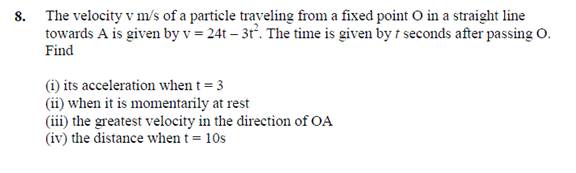
(click on the image for a bigger view)
