• Skip to primary navigation
  • Skip to main content
singaporeolevelmaths

singaporeolevelmaths

Simple Tips for Better Maths Results!

  • Pass With Distinction A-Maths Programme
  • About
  • Books
    • O-Level Maths Ten Years Series Books
    • O-Level Pocket Summary
  • Videos
  • What They Say
  • Contact

Archives for August 2009

E-Math: How to Translate a "Proportion Statement" Into an Equation

(Photo Credit:Jeff Keen)

I love to use everyday life examples to teach Math Concepts, it's more interesting to me and my students.

Today, I'm going to use the concept of 'See-Saw' to share with you on 'How to Translate a "Proportion Statement" Into an Equation'

At the end of this post, you will be able to translate all types of statement (be it inversely proportion or direct proportion) into an equation (some called it a formula)

Direct Proportion statement:

You need to first understand what's Direct Proportion (Read all about it here)

Let's look at an example: Given y is directly proportional to [pmath]{x^2}[/pmath], write an equation connecting x, y and a constant k.

So, in simple terms, when y increases, x increases too.

Inverse (Indirect) Proportion statement:

Given y is inversely proportional to [pmath]{x+2}[/pmath], write an equation connecting x, y and a constant k.

This is similar to the situation when a See-Saw is in Up-Down position. y is up while (x+2) is down. You can also see it from another point: y is in the numerator while (x+2) is in the denominator or when y increases, x decreases.

I hope you have understand the easier way to translate statements into equations for proportionality question.

In my next post, I will be sharing the various approaches in solving a proportionality question and the hint to look out for in order to use the correct approach.

Filed Under: E-Maths Tagged With: direct proportion, inverse proportion

E-Math: What is Direct Proportion and Inverse Proportion?

Proportion is a topic taught in Secondary 1 and 2. In fact, we have learnt about direct proportion much younger.

DIRECT PROPORTION

A real simple example of Direct Proportion would be the more money I have, the more things I can buy. When amount of money increases, the number things I can buy increase too. (Notice the increase in both things)

Another example, the less I eat, the thinner I become, so as the amount of food eaten decreases, my weight decreases too.

INVERSE PROPORTION

An example of inverse proportion most of you can relate to would be: the more time I spent on Facebook (PSP, WII, Internet), the less time I have on my books!

Allow me to add in another example of Inverse Proportion, the more I spent, the less I have in my bank.

These are some examples (simple) to understand the true meaning of Direct or Inverse proportion.

In the next post, I will be sharing with you how we can translate a statement into an equation involving proportion. I'm also going to highlight the 'tricky' proportion question in 2008 GCE O Level Elementary Mathematics Paper 1.

Filed Under: E-Maths, Weekly Question Tagged With: direct proportion, inverse proportion

Differentiation & Integration Mastery Workshop (Includes Kinematics too!)

Update: Click here for early bird registration.

Dear Students,

Do you know that Differentiation & Integration are 2 very important sections for O Level A-Math? Based on 2008 GCE O Level Additional Mathematics Papers, the weightage of Differentiation & Integration is almost 30%!

We received feedback from students and parents that due to time constraint, many schools rush through these 2 very important topics, leaving many students totally lost in their understanding. This coupled with the fact that Differentiation & Integration are totally new concepts for all A-Math students, made matter worst.
So with less than 7 weeks to GCE O Levels are you equipped with the tools and strategies to score in Differentiation & Integration or are you facing problems in understanding the concepts?

4 Days Differentiation & Integration Mastery Workshop

5, 12, 19, 26 Sep 2009, 2 - 6pm, YMCA Orchard (Tentative venue)


(Click on image for clearer view)

In this workshop, you will learn:

  • Comprehensive 100% coverage of Differentiation & Integration
  • Understand abstract concepts in an easy to relate manner
  • Learn and Apply strategies ('approved' short-cuts) on real examination questions
  • Time management enforced during every workshop
  • Pre & Post review assessment for checking level of understanding

Scope of the workshop:
Skills In Differentiation:

  • Basic Techniques of Differentiation
  • Differentiation involving trigonometrical functions
  • Differentiation involving exponential & ln functions

Applications In Differentiation:

  • Equations of Tangent & Normal
  • Connected Rate of Changes
  • Increasing & Decreasing Functions
  • Maxima & Minima Problems

Skills In Integration:

  • Basic Techniques of Integration
  • Integration involving trigonometrical functions
  • Integration involving exponential & ln functions

Applications In Integration:

  • Hence question (reversed differentiation)
  • Equation of curve
  • Area under the curve
  • Kinematics

Registration will open on 21st Aug 2009.(Update: Click here for early bird registration.)
This is the last workshop for O level students.

(Click on image for clearer view)

Filed Under: A-Maths Tuition, Press Releases, Tuition | Coaching Matters Tagged With: A-Math Revision, differentiation, integration, intensive revision programme

A-Math: Kinematics Step by Step Solution (Strategy To Answer Distance Question Correctly)

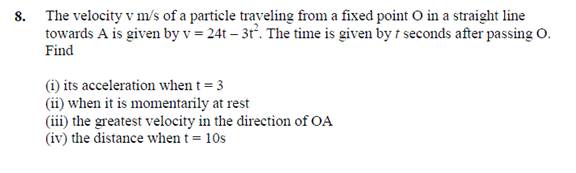
In the previous post on the typical questions on Kinematics, I am going to show up the step by step solution to answer a typical Kinematics exam question taken from my A-Math TREQ Book.

Things to take note:

  1. How to get the acceleration equation?
  2. What does it mean by 'momentarily at rest' ?
  3. How to find greatest velocity?
  4. *How to find distance accurately (using a diagram, I called it DD-Diagram; Displacement Distance Diagram)

Every year and in almost every paper, you will be asked to find Distance. The examiners are testing on your understanding of displacement, displacement, momentarily at rest. You must learn how to find it accurately and within the shortest period of time.

Learn from this example well!

(click on the image for a bigger view)

(click on the image for a bigger view)

Filed Under: A-Maths Tuition, The A-Math Book Tagged With: DD-Diagram, kinematics, vocabulary list

A-Math: Differentiation & Integration Application : Examples of Typical Kinematics Questions

I was looking through 2008 GCE O Level Additional Mathematics Exam Papers (Subject Code: 4038) and as expected, there was a Kinematics question (worth 6 marks) in Paper 1.

Kinematics is a application topic for Differentiation and Integration. To master this topic, you do not necessarily need to bring in your physics knowledge though it could be useful at times.

Instead, how I get my students to be a master in this topic is to be familiarize with a KINEMATICS VOCABULARY LIST.

Here's some of the vocabulary words that are useful and common:

  • Momentarily at rest, instantaneously at rest, changes direction of motion, stationary
  • Initial displacement, initial velocity, initial acceleration
  • Greatest displacement, greatest velocity, greatest acceleration
  • Distance travelled in the 4th second VS Distance travelled in the first 4 seconds
  • Maximum distance from Point O
  • Particle returns to Point O
  • Constant Velocity

I would say for Kinematics, it is one of the few topics in A-Math which uses extensive vocabulary. This is also the reason for you to decipher the meaning behind these words.

So do you know the meaning behind these words? I would love to hear about it in the comments section.

I have also taken a few questions from my A-Math TREQ book (Topical Real Exam Questions) to illustrate some common exam questions on Kinematics, further highlighting the importance of knowing your Kinematics well. (Click on the image for bigger view)

Click on image for a larger view

I would be sharing the step by step solutions for Question 8 in the next post. Subscribe to my blog to be updated again!

Filed Under: A-Maths Tuition, Exam Matters, The A-Math Book, Weekly Question Tagged With: differentiation, Exam Questions, integration, kinematics, Topical Real Exam Questions, vocabulary list

Copyright © 2026 · singaporeolevelmaths.com · Talk to us at 88290998