• Skip to primary navigation
  • Skip to main content
singaporeolevelmaths

singaporeolevelmaths

Simple Tips for Better Maths Results!

  • Pass With Distinction A-Maths Programme
  • About
  • Books
    • O-Level Maths Ten Years Series Books
    • O-Level Pocket Summary
  • Videos
  • What They Say
  • Contact

2014 GCE O-Level Elementary Maths 4016 Paper 1 (Post Mortem)


After completing this year O-Level E-Maths Paper 1, I personally find that the difficulty level has increased compared to the last 3 years.

I was slightly shocked to see question 1 as a arrangement question.Quite a handful of students commented that there are questions which aren't even Maths questions.

  • One of the questions is "Questionnaire on how much time does student spoil on Internet". It was probably what the question is asking for which brought some surprises to the candidates.
  • I found the cuboid, cube and the equal area of rectangles questions well crafted.
  • The train leaving tunnel was sneaky. It reminded me of PSLE Math.
  • I like the number pattern question as it has a twist to it. Instead of listing down the first few terms, they skipped some terms. It was very refreshing.
  • One of the observations I have: 2014 Paper 1 has a few questions which are 3-5 marks for a single part. It seems to deviate from the usual short questions of 1 to 3 marks in the past few years.

Based on what were tested, we are logically make some guesses of what we are expecting in Paper 2. The following topics are what I'm suggesting and they are for reference only:

  • Standard form
  • Scales & Maps
  • Factorisation
  • Solving simultaneous equations
  • Solving fractional equations
  • Inequality
  • Subject formula
  • General shapes of graphs
  • Functions & Graphs
  • Quadratic equations & Graphs
  • Distance, speed and acceleration graphs
  • Construction of bisectors
  • Congruent & Similar Figures
  • Angle & Symmetry Properties of circles
  • Arc length, area of sector and radian measure
  • Pythagoras’ theorem and Trigonometry
  • Mensuration
  • Coordinate Geometry
  • Mean & SD
  • Cumulative frequency
  • Vectors (ratio of areas, magnitude, linked to coordinate geometry)

Regardless of how you think you have fared for Paper 1, continue to work hard for Paper 2 which is 9 days away. Practice daily!

All the best!

Edit: My view on O-Level exam answers as reported in 4 November 2013 TODAY papers.

Ai Ling views on exam answer heats up on web

 Source: http://www.todayonline.com/singapore/exam-answer-fever-heats-web
Filed Under: E-Maths, Exam Matters Tagged With: Exam Matters, post-examination

Integration: The Reverse of Differentiation


After I've completed my O-Level Maths Revision Differentiation workshop for a small group of Secondary 4 O-Level A-Maths students, I understood from them why a handful of them finds Integration challenging.

They get confused when differentiation is mixed within a question with integration! Are you just like them? Is your child facing the same problem too?

The three major topics for O-Level Additional Maths are:

  1. Trigonometry
  2. Differentiation
  3. Integration 

Having a great understanding in these topics is crucial to pass O-Level A-Maths with distinction! When you have a clear understanding of the differences between differentiation and integration, you then can solve fundamental differentiation or integration techniques questions. And this is important as there are so many applications questions on:

  • Property of integral
  • Equation of curve
  • Integration is the reverse of difference (I term it 'The HENCE concept' question)
  • Partial fraction in integration
  • Area under the curve
  • Kinematics

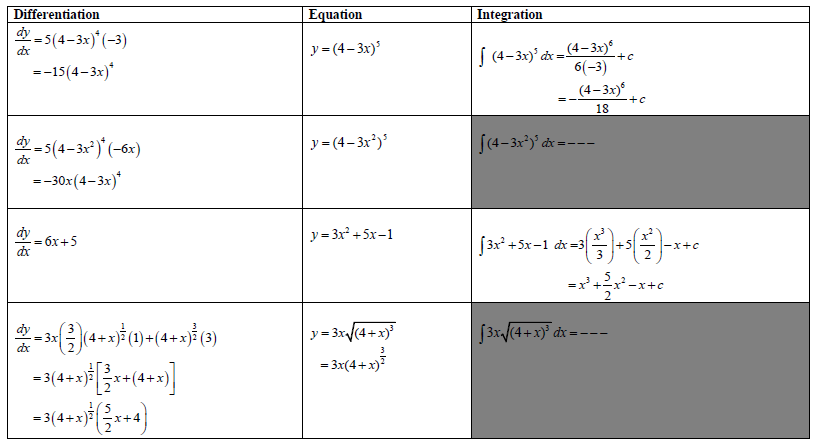
Let's take a look at comparisons between differentiation and integration questions:

(click on the image to view a larger size)

Comparison between differentiation and integration page 1

When you have a good understanding on how basic differentiation and integration rules are used in each question, you will be absolutely clear on the correct approach to take. All confusion will be transformed to confidence!

Many students need to be shown the comparison, taught the strategies, understand the reasons then they will be enjoying the topic happily.

If you have found this post useful, click on share on Facebook so that more students can benefit from this.

Pass With Distinction! Workshops

For students who are committed to be extraordinary, I would like to invite you to join me on my 4 days of O-Level Maths Revision: Integration Workshop on 3, 10, 17, 24 July 2014 (Thursday) from 6pm to 9pm. I will be sharing with you the strategies on Integration my students have used to pass their O-Level A-Maths with distinction.

This is exclusively for committed students who will do whatever it takes to turn their results around as they know deep inside them, they deserve better results as long as they are willing to work hard.

For registration, please go to www.PassWithDistinction.com.

PS: I've only 7 seats left.

I would like to share with you what Paxton has sent us after he received his O-Level results last year. He stays in Jurong and he was one of the committed students who showed up for several of our A-Maths Workshops last year, despite the distance from ACS(Br) to Winners Education back to Jurong, despite the long hours in schools, despite the fatigue, despite everything... He does not allow any factors to hold him back, his parents supported his decision... His commitment pays off handsomely for him. We are proud of his achievement and his determination in truly unleashing his potential.

PassWithDistinction.com: only for the committed.

Filed Under: Workshop Tagged With: differentiation, integration

Change in O-Level Elementary Maths 4016 Paper 1 Date


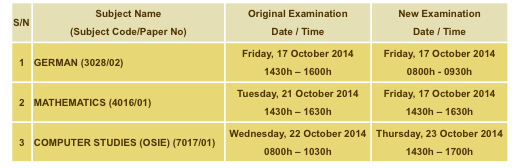
SEAB has made the following changes to the 2014 Singapore-Cambridge GCE O-Level Examination Timetable due to the change of date for Deepavali :

New date for O-Level Elementary Maths Paper 1 4016: 17 October 2014, 230pm - 430pm

O-Level E-Maths Change of Date

Change of date for O-Level Elementary Maths 4016 Paper 1 2014

Source: http://www.seab.gov.sg/notification/ChangestoTimeTable.html

Filed Under: Exam Matters

Differences between O-Level Additional Maths new and old syllabus


For Secondary 4 or 5 school candidates (in Singapore) taking the O-Level Additional Maths this year, many are likely to have registered for the new syllabus 4047. 

In this post, I would like to highlight the main differences between the new (4047) and old (4038) syllabus:

  • Matrices, Factor formula are excluded from the new syllabus
  • Intercept, Intersecting chord and Tangent-secant theorem are excluded from the new syllabus
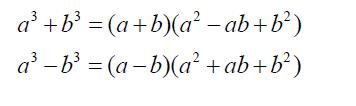
  • Sum and differences of cubes in Polynomials are included in the new syllabus

Sum and Differences of Cubes New Syllabus for Additional Maths 4047

In conclusion, since there are more exclusions than inclusions. We should be expecting more application questions which can be linked to everyday life applications in the fields of Biology, Chemistry, Physics, Engineering etc.

The keys to achieve distinction in O-Level Additional Maths are still:

  1. a solid foundation in basic concepts,
  2. well-equipped with application strategies,
  3. wide exposure to carefully selected application questions,
  4. good management of time for doing and checking
  5. exam-smart strategies

Filed Under: Exam Matters, private students, scorers mindset Tagged With: Maths syllabus

A-Maths: Factor-Remainder Theorem Introduction Videos


For many Secondary 3 A-Maths students, this topic called Factor - Remainder theorem or Polynomials is usually introduced in the first 3 months of the year.

In this topic, they are introduced to the method to find the factors of a cubic equation so that it can be solved. They also learnt when and how to use Remainder theorem to find the remainder when a dividend is divided by a divisor.

They also know to rewrite an expression into function f(x).

In the following two videos, I use less than 6 minutes to bring across the concepts of Factor theorem and Remainder theorem.

I hope through these videos, you will have a better understanding of these two concepts.

Also, I have included a page which contains all the O-Level Maths videos I have produced since 2007.

Filed Under: Video Learning Tagged With: factor remainder theorem, polynomial

E-Maths: Probability in everyday life


Recently, during the Chinese New Year period, I saw many people queuing up at Singapore Pools. For readers from other countries, Singapore Pools is like a betting station for lottery and sports. It was around the same period in which I was preparing to start teaching Probability to my Secondary 4 Elementary Maths students.

I decided to share with them on the probability of winning a number as a teaser to the topic. I did a poster and shared it on my Facebook. I was humbled by the response - the poster was shared 29 times! 

I believe the 'truth of winning' relates well to many people.

Details of a 4D game:

  • There are a total of 23 winning numbers which consist of 1st, 2nd, 3rd prizes, 10 starter prizes and 10 consolation prizes.
  • You may choose any 4 digit numbers from 0000 to 9999.
  • The following poster shows that to win any prize, the chance is a mere 0.23%

How often do we fall into the trap of greed, thinking that we can be lucky one day and win some money? In the end, who is the big winner? I'm sure you have the answer.

Whether you are a parent or student, I hope this blog post has shed some light on winning 4D game through the application of Maths in everyday life.

Probability in Everyday Maths

Filed Under: E-Maths Tagged With: probability

  • « Go to Previous Page
  • Page 1
  • Page 2
  • Page 3
  • Page 4
  • Page 5
  • Page 6
  • Interim pages omitted …
  • Page 54
  • Go to Next Page »

Copyright © 2026 · singaporeolevelmaths.com · Talk to us at 88290998